|
| |
|
|
                 
|
Beardmore’s Report 1870: Tedmonbury Lock is in bad repair Childs’ Report 1880: Tedmanbury; Brickwork upper and lower ends requires considerable repair. Side main piles nearly gone, require entire new sides within 2 or 3 years. Upper gates new 2 years ago, lower gates moderate. Sills deep enough. Childs' 1884 Report: ''Brickwork, upper and lower ends require considerable repair, side Main Piles nearly gone, requires entire new sides. Upper gates new 2 years ago, in fair condition; lower gates old, only poor state.|"
Tween's 1901 Report: "Brickwork. Upper and lower ends require considerable repair. side Main Piles nearly gone; requires entire new sides. Upper gates 1874, in fair condition. Lower gates old, 1856, very poor state. Cost for repairs about £300."
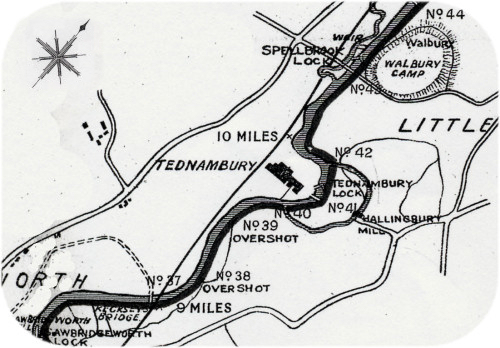
The lock derives its name originally from the Suffolk town of Bury St Edmunds. The religious order there once owned land at the nearby hamlet of Tednambury. The associated mill (originally called Tednam Mill) lies to the east and was first noted in 1641. The mill was rebuilt as a silk mill in 1693. In 1778 it was converted to a corn mill. The current water mill was built in 1874 and remained in use until 1952. The millstream now provides sheltered moorings complete with a dry dock.
In 1910, The Lee Conservancy and the miller at Hallingbury Mill came to an agreement regarding the maintained water level above the lock. (Deed 201) This plate records the agreement. The wording is:
"The Lee Conservancy Board Stort Navigation The 12 inches range marked on this plate denotes the working head for this mill as arranged by agreement made and dated September 6th 1910 between the owner of this mill and the Lee Conservancy Board Top Level Range 3 6 12 Inches 9 Bottom Level"
The plate is located on the wing wall above the lock and is not normally visible unless the water level is reduced. Photo: Paul May
In 1932/33 Messrs Ellis & Son, owners of Hallingbury Mill, claimed the right of using Tedmanbury Lock for passing flood water. This was denied by the Lea Conservancy Board who suggested Ellis should put in larger floodgates at the Mill. It was noted that Tednambury Lock is built on a length of artificial cut and has never been used for the passage of flood water. The Board maintained their right not to use the cut for flood relief. (NA Rail 845/116)
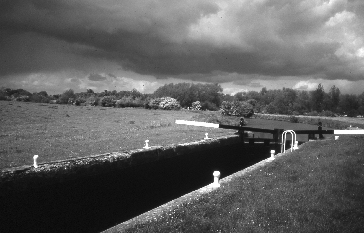
The lock was originally built as a turf sided chamber and was rebuilt in concrete in 1919 and 1920. The millstream follows the line of the trees to the right
It is an isolated lock in the middle of a field, often visited by the local cattle. It is wise to watch your step....
|
||||||||||||||||||||||
This site was last updated 30/01/15
 Griggs’ Report
1844: No 12 Lock called Tednams Bury Lock is affected by a Mill; has a
bridge with 4 oak timbers and oak planks. Old and in middling repair.
Headway 6’ 3’’. Depth of water on lower sill 4’ 0’’; ditto on upper sill
3’ 9’’. Brickwork good; the lower gates are much worn and in middling
order; dated 1816. Upper gates good; dated 1839. This lock except the
lower gates is in good repair.
Griggs’ Report
1844: No 12 Lock called Tednams Bury Lock is affected by a Mill; has a
bridge with 4 oak timbers and oak planks. Old and in middling repair.
Headway 6’ 3’’. Depth of water on lower sill 4’ 0’’; ditto on upper sill
3’ 9’’. Brickwork good; the lower gates are much worn and in middling
order; dated 1816. Upper gates good; dated 1839. This lock except the
lower gates is in good repair.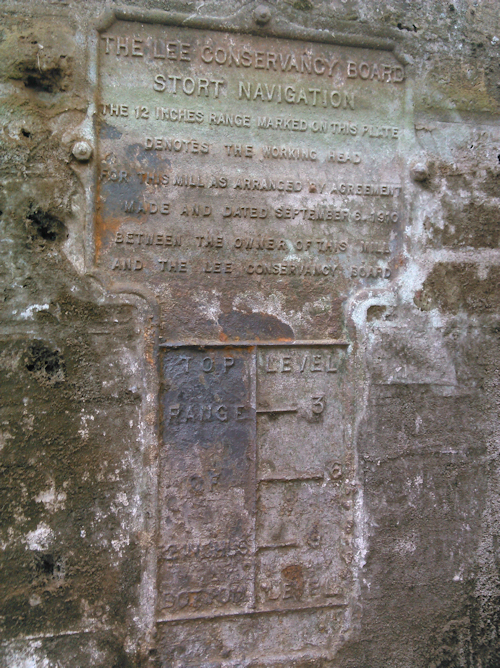 There
is a fine example of a Miller's Plate at Tednambury Lock.
There
is a fine example of a Miller's Plate at Tednambury Lock.