|
| |
|
|
|
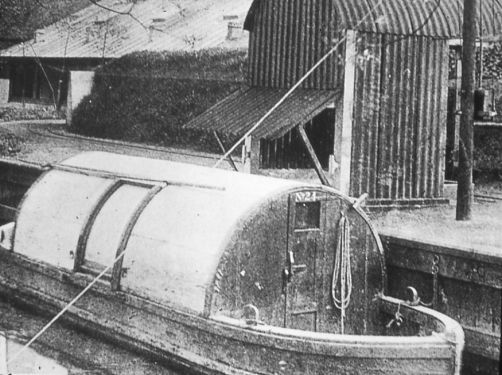
The boats used in the Mills varied in size but kept to two basic patterns. The first type was ship–ended and the other swim or square-ended. Both types were "double ended" so that they did not need to be turned but could be towed or poled from either end. Both types were carvel-built in timber and had barrel shaped roofs; phosphor bronze nails and fittings were used throughout. The hull and the cabin framing were made of sturdy timbers but the roof cladding was of canvas covered light planking. The canvas was to prevent contamination of the cargo and the light planking allowed explosive force to dissipate in the event of an accident. There is no record of one of these boats exploding at Waltham Abbey.
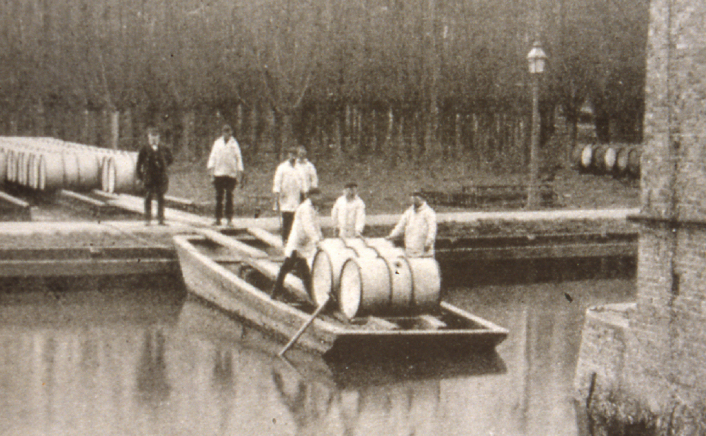
A swim-ended boat used (in this instance) for ferrying drums of acetone. (RGPF Waltham Abbey)
The doors at each end were for access and the canvas side hatches for loading and unloading cargo. Towage was always provided by men, never horses or donkeys. The thought of a horse bolting when towing a boat laden with explosives must have been influential when this rule was made! The towing line was only used for towing, not for tying up. A special hook was provided for storage of the line.
Powder boat ready to load or discharge cargo. RGPF, Waltham Abbey
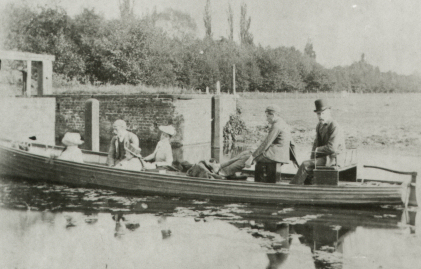
"Spark" (RGPF Waltham Abbey) In addition to these boats, Colonel Noble, superintendent from 1885 to 1892, had a battery powered launch called 'The Spark' constructed for his internal communications around the factory. It was also equipped to provide electric lighting to buildings that were not connected to the dynamos. Another specialised barge in use on the factory's canal system was a dredger with a grabbing crane built by Priestman Brothers of Hull and London.
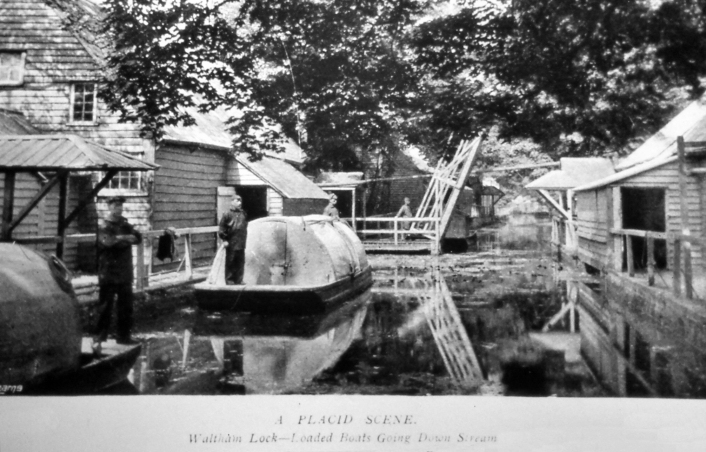
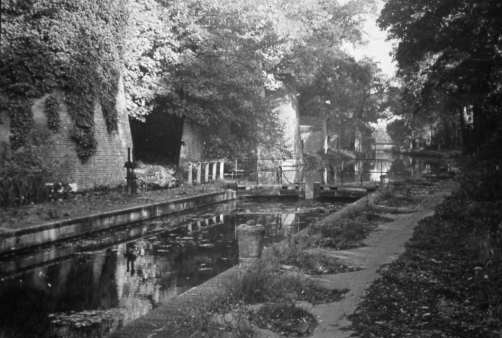
A view looking north up the Millhead Stream. (RGPF Waltham Abbey)
The following extract is taken from the Rules of the Royal Gunpowder Factory, Waltham Abbey, issued in 1934. It gives a very good picture of how the canals and the boats were used at that time.
Boats for Explosives.
The Chargeman, or when no Chargeman is present, the senior Boatman is responsible for the observance of the following Special Rules:
1.-Boats are to be cleaned and examined before use; they are also to be examined for any leakage after loading. 2.-Boats containing explosives or their ingredients are not to be left unattended, except during a thunderstorm. 3.-The slides of Boats are to be shut, except when loading or unloading. The end doors are not to be left open. 4.-The leather pads and loading boards, where provided, are to be used when loading or unloading. 5.-The "clean" towing ropes are not to be used for mooring purposes. Boats are to be moored by passing the mooring ropes through the rings on the wayling, (wharf side) and securing them. 6.-Boats in motion are to be kept clear of the waylings and banks. 7.-Boat poles are not to be used in puddled (waterproof clay bottom) cuts. 8.-The floors and platforms of all Gunpowder Danger Buildings are to be wetted before loading into and unloading from boats. 9.-Boatmen are to see that bags containing explosives are securely tied up before they are loaded into or unloaded from boats. 10.-Boats with explosives are not to approach, or be moored within the red boundary posts of any Danger Building displaying a red signal, until the signal has been lowered. 11.-Boats with explosives are not to approach, or be moored within the red boundary posts while a boat is being loaded or unloaded under the hood at the Lower Island. 12.-Boats either with explosives or empty are not to be taken under any bridge if anybody is standing on or crossing over the bridge. 13.-Boats with explosives are not to pass any barge or boat between the Lower Stores Yard crane and the entrance to the Lower Island Cut, until the boatmen have ascertained that there is no fire or light on board such barge or boat. 14.-Should a barge be passing through the water lying between the Hospital and the Lower Stores Yard crane, no boat with explosives is to enter that water until the barge has passed through, or has been moored so as to give a free passage. 15.-Boats with explosives are not to pass under the Refinery Bridge until the Chargeman has ascertained that no steam lorry or other dangerous traffic is in the vicinity. 16.-All boats passing up or down the Mill Head Stream are to keep outside the hoods of the Guncotton Stoves. 17.-When boats proceeding in opposite directions have to pass one another, the boat going up stream is to take the inside (towing path) station. 18.-For opening and closing lock gates, the ropes and chains provided are to be used. The hand rails are not to be used for these purposes, and the ropes are to be first cast off from the hooks. When done with, the ropes are to be recoiled and replaced clear of the water, on the hooks. Lower gates of locks are not to be closed by opening the upper slackers and allowing a rush of water through the lock. 19.-The boats belonging to No. 2 Granulating House and No. 1 Breaking-down House, are to be moored inside their respective boat-houses, when their Danger Buildings are at work. 20.-On the cessation of work at the end of the shift, day, or week, boats are to be emptied and cleaned out, and moored at the places appointed. Boats used for dry guncotton, or paste, are to be thoroughly washed out with a hose every six months. 21.-Boats containing explosives are not to approach within 30 yards of boats or other apparatus containing internal combustion engines until such engines have been stopped.
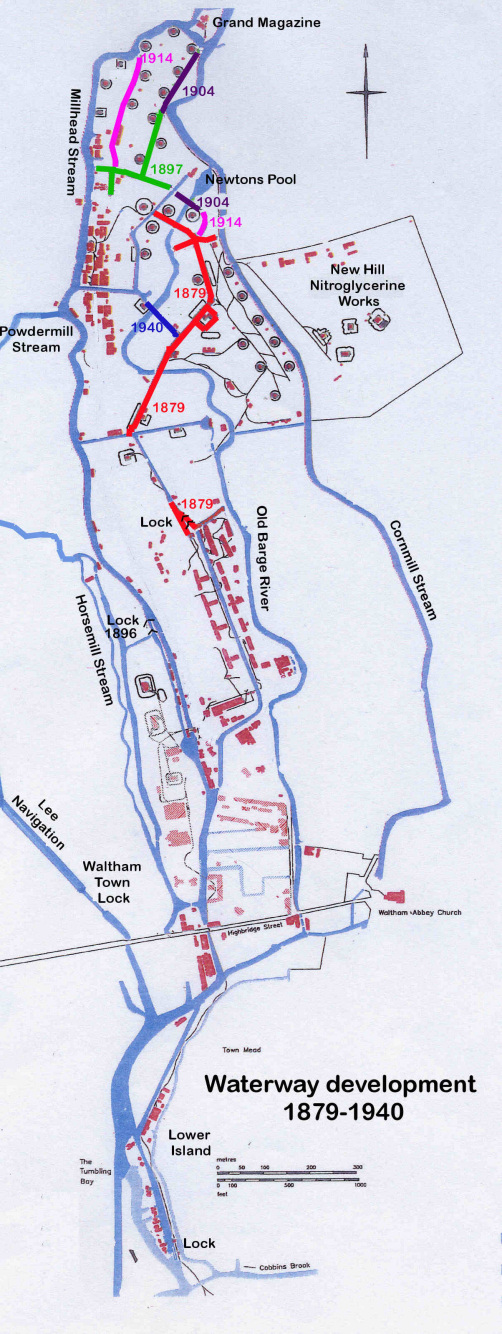
The next surge of canal building came in 1878-9. The waterways were needed for access to the new nitro-glycerine, guncotton and cordite processing buildings. This expansion provided two cast iron aqueducts where the canals crossed the River Lea and a lock which connected the upper and lower levels of the canal system, as well as over a thousand yards of waterway.
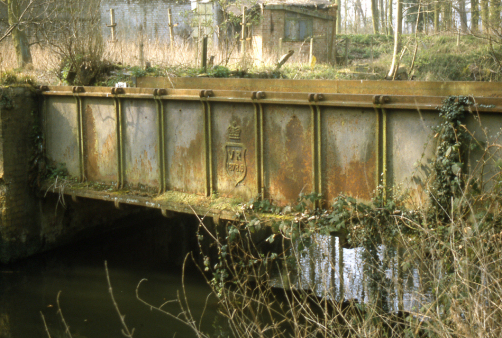
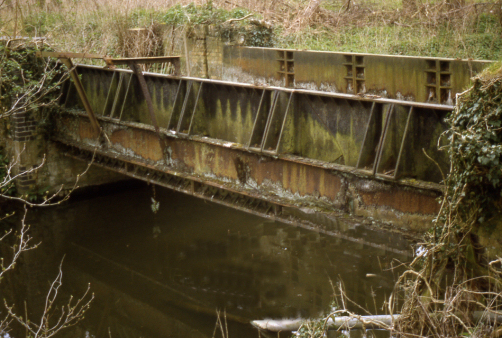
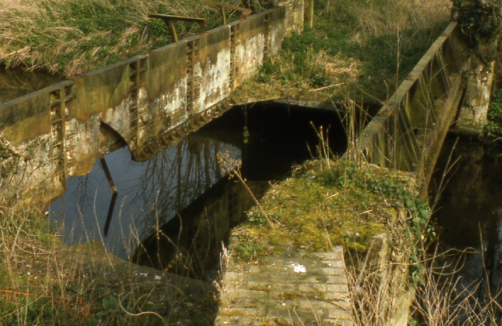
Aqueduct near the Burning Ground (Richard Thomas) The aqueducts were probably floated into position on barges on the Lea, as they are both made of two side plates, each a solid casting, bolted to the base plates on site. One survives in very good condition and can be seen just south of the Burning Ground. The other, near Newton’s Pool, has a later footway bridge installed across it after the canal system fell into disuse. Both carry plaques recording the building date and the VR insignia. There are only 23 cast iron aqueducts on the whole English waterway system and three of them are within the Mills. (The third was installed in 1904)
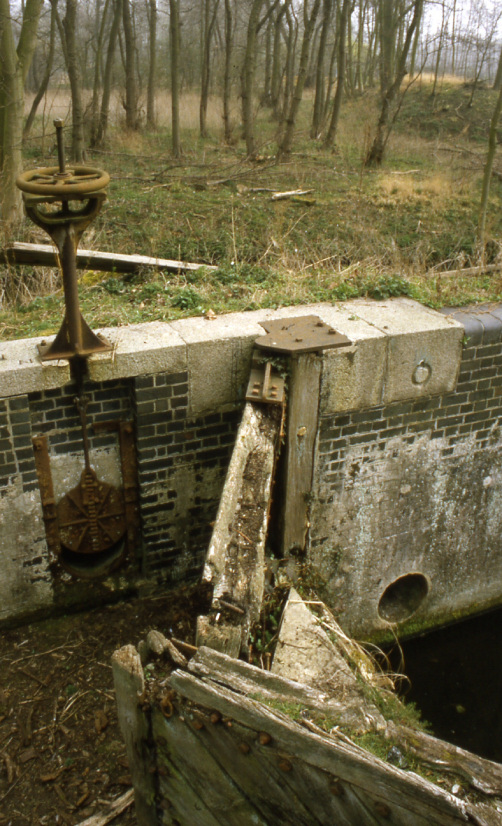
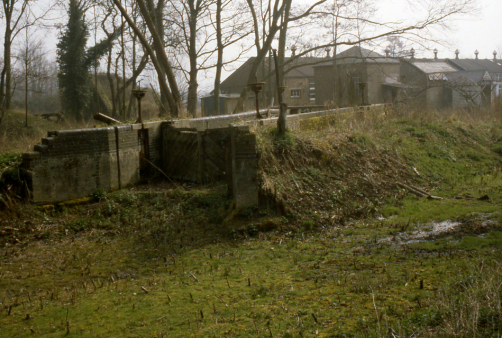
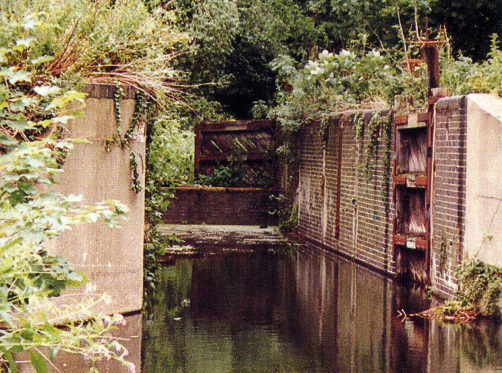
Detail of the paddle gear View of the 1878-9 lock chamber Richard Thomas
The lock was built to link the existing channel serving the Blank Cutting House (this building has been restored and is open for inspection) and the canal connecting with the Incorporating Mills on Queens Mead. Although the lock appears to protrude above the surrounding landscape, it must be remembered that decontamination removed about two feet of topsoil. The original water level can be easily judged by the white lime staining on the abutments. The paddle and sluice gear are of particular interest. The culverts are quite small and circular in section. The sluice gates are made of cast iron and are similarly circular in shape. The paddle gear is operated by a worm drive. These features would combine to make it impossible to fill the lock quickly. There would have been virtually no turbulence to throw the powder boats about, thus minimising the risk of banging the boat against the lock-side with possible catastrophic results. It also seems that the men who built the lock did not assume that the Mills’ boatmen knew about lock operation; carved into the granite coping stones by the paddle gear at the top and bottom of the lock are the words “IN” and “OUT”!
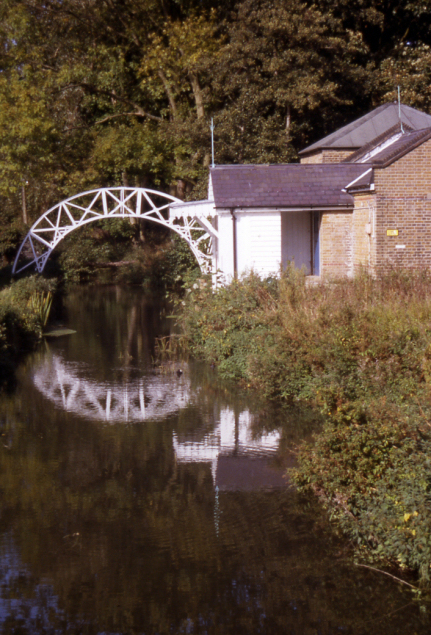
The footbridges over the canals were built to allow passage of the semi-cylindrical boats that carried the raw materials around the site. If a boat was passing through a bridge, men were forbidden to cross for fear that grit falling from their boots might contaminate the cargo. The bridge pictured is situated just south of the lock, by the observation tower which has been converted from the hydraulic accumulator house.
RGPF Waltham Abbey
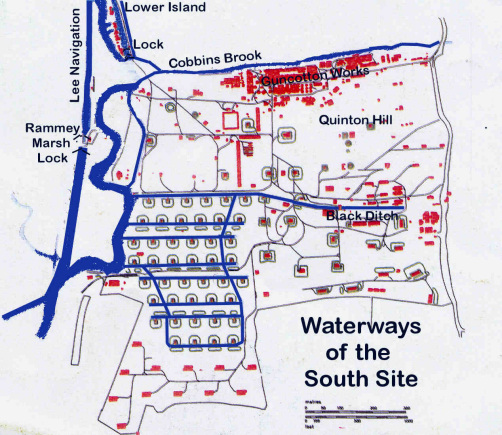
In 1888, the acquisition of Quinton Hill Farm to the south of the Lower Island allowed the Royal Gunpowder Mills nearly to double their size. Nitroglycerine, guncotton and cordite were all manufactured on this new South Site. There was an extensive waterway system accessing the cordite drying stoves. Lower Island Lock, (RGPF, Waltham Abbey)
A lock was built at the southern end of Lower Island to allow waterway connection to the new area, without using the Lee Navigation which would have attracted a toll.
The rest of the South Site was served by a narrow gauge railway system, which provided a rail link, via Lower Island, to the network of railways that had grown on the North Site.
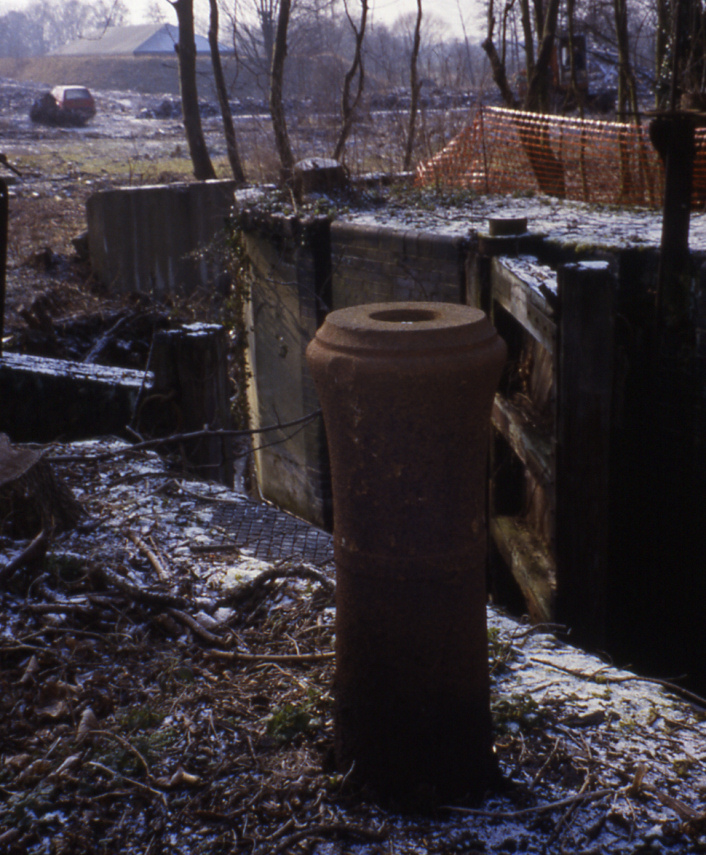
In 1896, the last of the four locks of the Royal Gunpowder Mills complex of waterways was built connecting the Millhead Stream to its own tailstream level, six feet below. This enabled a more direct route from the South Site and Lower Island to the Grand Magazine at the north end of the North Site
A redundant gun barrel has been upended and used as a mooring bollard. (Richard Thomas)
The 1896 chamber, which can be viewed from the north-east corner of the car park Christine Richardson
By 1897, the increase in demand for cordite instigated the building of even more cordite drying stoves at the northern end of the North Site and the First World War created still further demand. The resultant extension of the waterways serving these new buildings brought the canal system to its maximum extent of nearly10 miles.
Richard Thomas Richard Thomas
The third cast-iron aqueduct was installed in 1904, again over the River Lea. This one was of a different design, being supported on two girders and built in sections. The remains of the brackets which supported the towpath fixed to the northern side of the aqueduct can still be seen.
The bottom plate has fractured and fallen away, possibly as a result of two nearby massive nitro-glycerine explosions in 1940.
The canals were used up to the time of the Second World War, though with decreasing frequency. The railway system was easier to maintain and extend and, just as in the outside world, it gradually supplanted the canals. When the guncotton drying stoves on the west bank of the Cornmill Stream were built in the first decade of the 20th century, railway track was laid to link them to the production process. When the New Hill area was developed in the 1940’s, that too, only had a rail link.
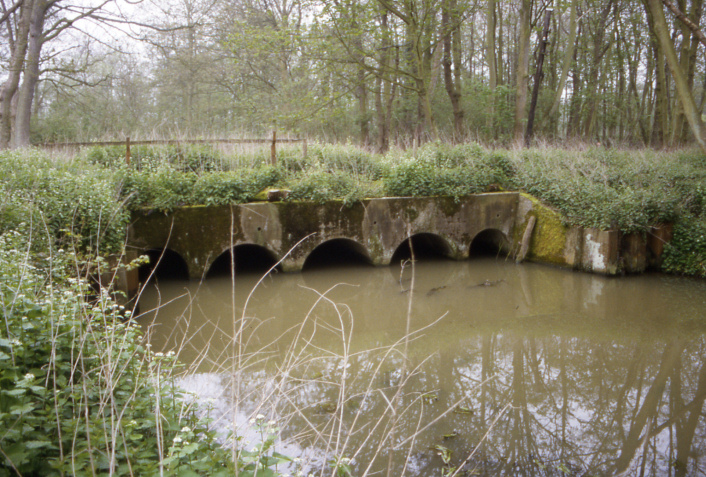
There was one small waterway link created in 1940. The mixing house at the end of the original northern 1806 canal was linked to the 1878/9 system by an aqueduct over the River Lea and a short length of canal to meet the sidecut serving the No1 Mixing House. The aqueduct was obviously a product of the austerity years. It consisted simply of concrete pipes laid side by side in the bed of the river with a concrete channel built over the top. No cast iron and royal insignia for this one, just the date cast in the concrete!
1940 Aqueduct (Richard Thomas)
Since the Royal Gunpowder Mills closed on 25th July 1945 and reopened on 31st July as a Research Establishment, no use has been made of the canal system. Many of the waterways at the north end drained or became choked with weed . Even where they remained partially in water, they became part of a secret nature reserve. This was rudely disturbed when the site was decontaminated in the early 1990’s but since the machines left it has not taken long for nature to reassert itself.
The South Site has disappeared, partly under a housing estate and partly under the Sainsbury's Distribution Depot and parts of Lower Island are under the M25 and the Lee Flood Relief Channel.
The south-western and southern part of the North Site has also gone to housing. The remaining area comprises the Royal Gunpowder Mills, Waltham Abbey, open to the public.
Here the surviving waterways and the ruins and restored buildings on their banks bear witness to a sometimes explosive but always fascinating past.
|
This site was last updated 02-Aug-2014